Suspended ceilings are one of those elements of commercial fit out that most business owners don't think about until they're standing in an empty office unit staring at a mess of exposed pipework, ductwork and cabling above their heads. Then they think about it quite a lot.
The right suspended ceiling does several important jobs simultaneously. It conceals all of that infrastructure. It integrates your lighting. It manages acoustics in open-plan environments. It gives the space a clean, finished appearance that makes everything else in the office look more considered. Done well, it's invisible, people simply experience a workspace that feels professional and complete.
This guide covers everything Kent and London businesses need to know about suspended ceilings inc. the different types, what each is suited to, what's involved in installation, and how ceiling choice fits within the context of a wider office fit out or office refurbishment.
TJW Designs installs suspended ceilings across Rochester, Chatham, Maidstone, Dartford and the wider Kent and South East London area. Here's what we tell our clients.

Office fit out completed by TJW Designs Rochester Kent showing open plan workspace

Walk into a well-fitted commercial office and you probably won't notice the ceiling. That's the point. A properly specified and installed suspended ceiling creates a clean, even overhead plane that lets the rest of the space e.g., the partitions, the flooring, the furniture, do the visual work.
Walk into a poorly fitted or absent ceiling and you notice immediately. Exposed building services are visually distracting, acoustically problematic, and in older buildings they often tell an unflattering story about how much investment the space has seen over the years.
Beyond appearance, suspended ceilings serve three practical functions that matter to any business occupying a commercial space.
First, they conceal. The void between the suspended ceiling and the structural soffit above it (the ceiling plenum) houses electrical cabling, data infrastructure, mechanical ductwork, sprinkler systems and other building services that need to be there but don't need to be seen. Concealing this infrastructure is one of the first things a commercial fit out achieves.
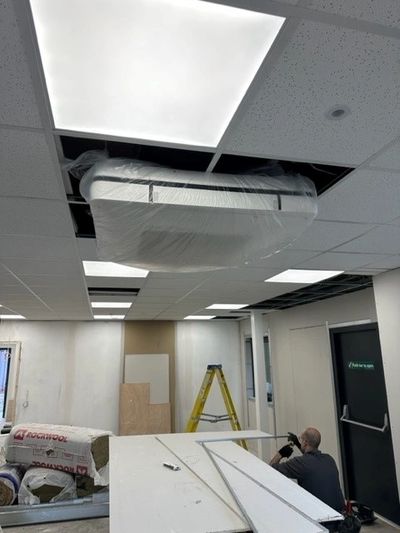
Second, they integrate. Modern suspended ceiling systems are designed to accept lighting panels, air conditioning units, smoke detectors, sprinkler heads and access hatches cleanly and precisely. The ceiling becomes the platform from which the office's services operate, rather than a surface that those services have to work around.
Third, they perform. Acoustic tile systems actively reduce sound transmission and reverberation in open-plan offices. This matters more than many businesses initially appreciate, the acoustic environment of a workplace directly affects concentration, communication quality and how comfortable the space feels to spend time in.
The grid suspended ceiling, also called a lay-in grid or T-bar ceiling, is the most common commercial ceiling system. A metal grid is suspended from the structural soffit on wire hangers, and ceiling tiles or panels drop into the grid from above.
The practical advantages are significant. Individual tiles can be lifted for access to the void above, essential for maintenance of the building services concealed there. The system is relatively straightforward to install, well-understood by all trades, and cost-effective at most specification levels.
Grid ceilings accept a wide range of tile types, inc. standard mineral fibre tiles, acoustic tiles, tiles with integrated lighting, and tiles with built-in air conditioning diffusers. This flexibility makes them suitable for most commercial office environments.
The aesthetic is utilitarian rather than premium. For standard office environments across Medway and Kent's commercial parks this is perfectly acceptable, the ceiling does its job without drawing attention to itself. For client-facing spaces in Sevenoaks or Tunbridge Wells professional services offices where the finish standard is higher, a grid ceiling might be combined with feature sections or replaced entirely by an MF ceiling in key areas.
MF stands for metal furring, a ceiling system where a metal framework is fixed to the soffit and plasterboard is applied to create a seamless, solid ceiling surface. The result looks like a traditional plastered ceiling rather than a grid tile system.
The aesthetic is noticeably cleaner and more premium than a grid ceiling. There are no visible grid lines, no tile edges, no breaks in the surface. Paint finishes, curved profiles and integrated features are all achievable. For reception areas, boardrooms and client-facing spaces where the ceiling finish contributes to the overall quality impression, MF ceilings are the standard choice.
The trade-off is access. Unlike grid ceilings, MF ceilings don't offer the same easy access to the void above. Access hatches can be incorporated but they're disruptive to the visual continuity of the surface. For spaces with building services that need regular access, MF ceilings are less practical than grid systems.
MF ceilings are also more expensive and more labour-intensive to install. For larger open-plan offices, the cost difference over a grid ceiling is significant. Most office refurbishment projects use a combination of grid ceilings in the working areas, MF in the reception and meeting spaces.
Acoustic ceilings are grid ceiling systems specified with tiles designed to absorb rather than reflect sound. The tiles have a higher noise absorption coefficient than standard mineral fibre, typically Class A or Class B rated under BS EN ISO 11654.
In open-plan offices, sound travels freely. Conversations carry. Phone calls become background noise for everyone in the space. Keyboards, printers and general office activity accumulate into an acoustic environment that makes concentration harder and communication more tiring.
Acoustic ceiling tiles address this at the overhead plane, the largest surface in most offices and one of the most effective positions for sound absorption. Combined with acoustic office flooring and soft furnishings in breakout areas, an acoustic ceiling system makes a substantial difference to how an open-plan office feels to work in.
For larger offices across Dartford, Gillingham and Maidstone where open-plan working is the norm, acoustic ceiling specification is worth the modest additional cost over standard mineral fibre tiles.
Not all suspended ceilings are flat planes. Feature ceilings such as curved profiles, stepped levels, bulkheads, integrated lighting coves add architectural interest and can define different zones within an open-plan space.
In reception areas, curved ceiling features create a sense of arrival and quality that a flat grid ceiling can't match. In breakout spaces, a lowered ceiling zone with warm lighting creates an atmosphere that distinguishes the informal area from the working floor. In open-plan offices, ceiling bulkheads can mark circulation routes or team zones without the need for full-height partitions.
Feature ceilings require more detailed design and more complex installation than standard systems. They're most relevant in higher-specification office fit outsand for businesses in Tunbridge Wells, Sevenoaks and client-facing locations where the design of the space is a business asset.
Some contemporary office designs deliberately leave the structural soffit exposed, painted out in dark grey or black to recede visually, with services either concealed through careful routing or left intentionally visible as part of an industrial aesthetic.
Open plenum ceilings suit creative, tech and media businesses where the exposed structure communicates the right cultural signal. They're less appropriate for professional services, healthcare or corporate environments where a polished, finished appearance is expected.
The practical implication is that all building services need to be either neatly routed and presented or genuinely worth looking at. Random conduit runs and mismatched pipework don't work aesthetically without a proper exposed services design. For conversions of warehouse and industrial buildings into offices (increasingly common in the Medway and Dartford areas) a well-designed exposed ceiling can be more cost-effective than a full suspended ceiling installation while delivering a distinctive result.
The ceiling void is the functional core of a suspended ceiling. Understanding what needs to go in it determines the void depth required, which affects floor-to-ceiling height in the finished office.
A typical ceiling void contains some or all of the following: electrical cabling and containment, data cabling, mechanical ductwork for heating, ventilation and air conditioning, sprinkler pipework and heads, fire alarm detection and cabling, and lighting fittings or recessed panels.
Void depth requirements vary by what's above. A simple electrical and data installation might only need 150 to 200mm. Full mechanical and electrical services with ductwork typically require 400 to 600mm or more. In older Kent commercial buildings with lower floor-to-structural-soffit heights, void depth is often a genuine constraint that affects which ceiling system is practical.
We assess ceiling void requirements during the site survey, it's one of the first things that needs to be understood before a ceiling specification can be confirmed.
Lighting is the most visible element of suspended ceiling integration. Modern LED panel lighting fits directly into standard grid ceiling modules. Typically 600 x 600mm panels that replace standard ceiling tiles, or into recessed apertures in MF ceilings.
The quality of the lighting specification has a significant impact on how the office looks and how comfortable it is to work in. Standard LED panels provide even, functional illumination. Higher-specification panels with better colour rendering and lower glare indices make a noticeable difference to the working environment. Dimmable systems and tunable white light (which adjusts colour temperature through the day) are increasingly specified in offices where wellbeing and productivity are priorities.
Emergency lighting, which maintains minimum illumination in the event of power failure, is a building regulation requirement and needs to be incorporated into the ceiling design from the outset.
Suspended ceilings interact with the building's fire safety systems in ways that need careful attention. Sprinkler heads need to be at the correct height below the ceiling surface. Fire alarm detection needs to be both below the ceiling (in the occupied space) and above it (in the ceiling void, where a fire could develop before being detected below).
Fire-rated ceiling tiles and systems are required in certain locations, particularly above office partitions and in fire compartment boundaries. Using non-rated tiles where rated tiles are required is a compliance failure that building inspectors and insurers take seriously.
We manage all fire safety and building regulation compliance as part of our ceiling installation service. It's not something you should have to navigate independently.

Open-plan office
- Acoustic grid ceiling
- Sound absorption, easy access, cost-effective
Reception area
- MF ceiling or feature ceiling
- Premium finish, client impression
Meeting rooms
- Acoustic grid or MF
- Acoustic performance, appearance
Boardroom
- MF ceiling
- Clean, professional finish
Breakout space
- Feature or acoustic grid
- Atmosphere, acoustic management
Warehouse office
- Standard grid ceiling
- Practical, durable, cost-effective
Circulation corridors
- Standard grid ceiling
- Functional, access for maintenance
Building type shapes what's practical and what's possible.
Older commercial buildings in Rochester, Chatham and Maidstone town centres often have lower structural soffit heights than modern builds. This limits void depth and may mean certain mechanical systems need to be routed differently to achieve an acceptable finished ceiling height. In some cases, a slim-depth grid system or an MF ceiling closer to the soffit is the only viable option.
Modern business park units, common along the A2 corridor in Dartford and at Gillingham Business Park, typically have generous floor-to-soffit heights and straightforward structural soffits. They offer the most flexibility in ceiling system choice and void specification.
Listed and historic buildings in Sevenoaks, Tunbridge Wells and Rochester's historic areas may have restrictions on fixing systems to the structural fabric. We advise on compliant approaches during the site survey.
Suspended ceiling costs vary significantly by system type and specification level.
Standard grid ceiling
£25-40 per sq mtr
Acoustic grid ceiling
£35-55 per sq mtr
MF plasterboard ceiling
£45-70 per sq mtr
Feature or curved ceiling
£65-120+ per sq mtr
For a 2,000 sq ft office, a standard acoustic grid ceiling typically costs £7,000 to £12,000 installed. MF ceilings in the same area run £10,000 to £15,000. Feature ceiling elements in reception areas add cost on top of the base ceiling installation.
As with office flooring, the specification decision should be based on the function of the space and its role in the overall office design, not purely on minimising upfront cost.
Suspended ceilings don't exist in isolation. They're one element of a coordinated office refurbishment or fit out, and the ceiling specification affects and is affected by several other elements of the project.
Office partitionsand suspended ceilings need to be coordinated carefully. Partitions typically run up to the underside of the suspended ceiling, and the ceiling grid needs to be planned around partition positions to avoid awkward tile cuts and misaligned grid lines. Where partitions divide spaces with different acoustic requirements e.g., a meeting room within an open-plan office, the ceiling above needs to address the acoustic separation between the two zones.
Office flooring and ceiling specification work together acoustically. Hard flooring throughout an office with a standard mineral fibre ceiling creates a livelier acoustic environment than carpet tiles combined with acoustic ceiling tiles. The two specifications should be considered together rather than independently.
Lighting design connects directly to the ceiling. The grid module size and ceiling type determine which lighting products are practical and how they'll be positioned. Feature lighting in reception areas needs to be planned within the ceiling design from the outset — retrofitting lighting features into an installed ceiling is significantly more expensive than incorporating them during installation.
From a programme perspective, suspended ceilings are typically installed after partitions are up and first fix electrics and mechanical services are complete. The ceiling installation closes in the void and makes the space ready for second fix, flooring and finishing. Getting the sequence right is part of project management, on a TJW project this is coordinated as part of the overall programme, not left to individual trades to sort out independently.
These are the issues we see causing problems for Kent and London businesses:
Insufficient void depth. Not assessing mechanical and electrical requirements before fixing ceiling height leads to either compromised services routing or a finished ceiling height that's lower than it should be. Assess void requirements before anything else.
Wrong tile specification for acoustic requirements. Standard mineral fibre tiles in a large open-plan office with hard flooring creates an acoustic environment that makes the space unpleasant to work in. Specify acoustic tiles where acoustic performance matters.
Ignoring fire safety requirements. Non-rated tiles in fire compartment boundaries, missing above-ceiling detection, incorrectly positioned sprinkler heads. Fire safety compliance in ceiling installations is not optional and not something to discover during building control inspection.
Misalignment with partition layout. Installing a ceiling grid without coordinating it with the partition layout produces a ceiling that looks unresolved, cut tiles at partition lines, grid running in the wrong direction. Plan ceiling and partitions together.
Choosing MF throughout for cost reasons then being surprised by access costs. MF ceilings look better but provide poor access to the void. If your building services require regular access, the ongoing maintenance cost of cutting and repairing MF access points will outweigh the initial saving on tile cost.
Underspecifying in client-facing areas. The ceiling in your reception area is the first thing clients see when they look up. A standard grid ceiling where a more considered finish was warranted sends an unintended message about attention to detail.
Before your ceiling installation begins:
A suspended ceiling is a secondary ceiling installed below the structural soffit of a building, creating a void above it that houses building services. It's suspended from the structural soffit on a metal framework and finished with tiles, plasterboard or other ceiling materials. Most commercial offices have some form of suspended ceiling.
A grid ceiling uses a visible metal grid with tiles that drop into it from above. It provides easy access to the void and is cost-effective for large areas. An MF ceiling uses a metal framework with plasterboard applied to create a seamless, plastered finish. It looks more premium but provides less easy access to the void above.
Standard grid ceiling installation typically runs £25 to £40 per square metre installed. Acoustic grid ceilings are £35 to £55. MF plasterboard ceilings are £45 to £70. Feature ceilings with curves or special profiles are £65 to £120 or more. For a 2,000 sq ft office, a standard acoustic grid ceiling is typically £7,000 to £12,000 all in.
A standard grid ceiling in a 2,000 sq ft office takes two to three days to install once first fix services are complete. MF ceilings take longer, typically four to five days for the same area, plus time for plastering and painting. Feature ceiling elements add time depending on complexity.
Not typically for standard internal fit out work. You may need Building Regulations approval for fire safety alterations and structural fixings in some circumstances. We manage all necessary approvals as part of our service.
Yes, with careful planning. Ceiling installation is noisy and creates dust, so phasing and out-of-hours working is usually advisable for occupied spaces. We plan ceiling installation sequences to minimise operational disruption where offices need to remain partially occupied.
For open-plan offices, Class A or Class B acoustic tiles under BS EN ISO 11654 are appropriate. Class A provides higher absorption and is better for larger open-plan environments. For meeting rooms where speech privacy is important, consider acoustic ceiling systems combined with acoustic partitioning for the partition walls.
Suspended ceilings interact with sprinkler systems, fire detection and fire compartmentation. Ceiling tiles in fire compartment boundaries need to be fire-rated. Smoke detection is required both below and above the ceiling in most commercial installations. We manage all fire safety compliance as part of our ceiling installation service.
Yes, though older buildings in Kent sometimes present specific constraints around structural soffit height, fixing into historic fabric, and existing services routing. We assess all of these during the site survey and advise on the most practical approach before any work is specified.
A well-specified and properly installed suspended ceiling is one of the elements that separates a professional commercial workspace from one that looks unfinished. It conceals what should be hidden, integrates what needs to be there, and creates the overhead plane from which the rest of your office design operates.
TJW Designs installs suspended ceilings across Rochester, Chatham, Maidstone, Dartford, Gillingham, Gravesend, Sevenoaks, Tunbridge Wells and into South and East London, as part of complete office fit outs and refurbishments, or as standalone ceiling replacement projects.
Free, no-obligation consultation at your premises. We'll assess the space, advise on the right ceiling system for each area, and provide a clear proposal with pricing and timelines.
This website uses cookies. By continuing to use this site, you accept our use of cookies.